
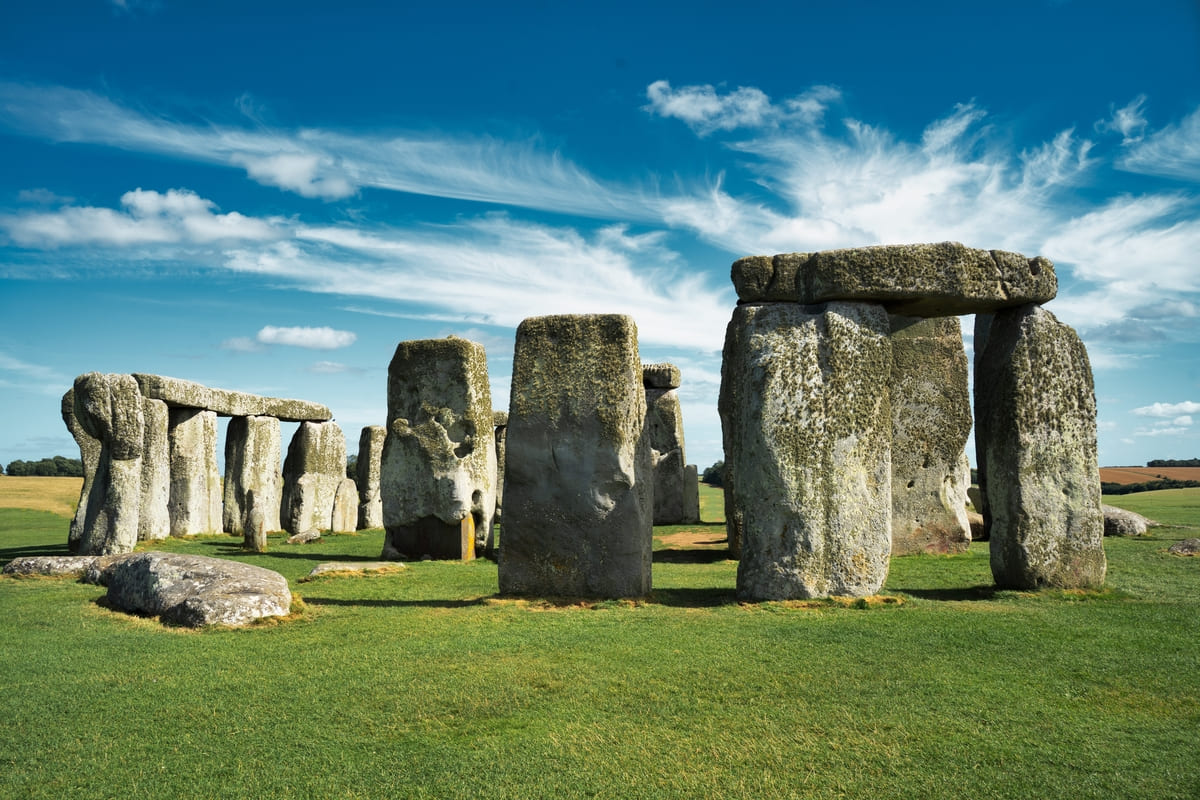
Stonehenge, a ring of giant stones in the plains of southern England, is one of the most mysterious ruins in human history.It is not clear when, who and why it was built.Nevertheless, it conveys the advanced knowledge and social structure of prehistoric people to the present day. In this article, we will not go into tourist information or visit reports,Stonehenge's historical and cultural valueBy systematically understanding the reasons why a site is recognized as a World Heritage Site, the book is structured to enable readers to quickly grasp the meaning of the site itself.
What is Stonehenge?
Stonehenge is a prehistoric megalithic structure located on Salisbury Plain in Wiltshire, southern England.A trilith structure consisting of a vertical megalith (standing stone) and a horizontal stone placed on top of it.The main feature of the area is that the structures are arranged in a circular and horseshoe shape. The current appearance was not completed all at once, but was developed in stages over a long period of time.
The stones used include large sarsen stones collected locally and bluestones that are said to have been transported from as far away as Wales.The technical ability to transport stones weighing tens of tons over long distances and place them in precise ordershows that people from the Neolithic to the Bronze Age possessed advanced organizational capabilities that went beyond simple hunter-gatherer societies.
The historical value of Stonehenge
Stonehenge is thought to have been built in several stages, from around 3000 BC to around 1600 BC, beginning with a circular ditch and earthworks, followed by wooden structures and smaller stones, and finally evolving into the massive stonework known today.Modifications over hundreds of yearsThis indicates that this place has been important for a long time.
In addition, remains thought to be related to tombs and rituals have been discovered in the surrounding area, proving that Stonehenge is not just a monumental structure.Possible social and religious centerThere are several theories about the purpose of its construction, including that it was a cemetery, a place of worship, or an astronomical observatory, all of which provide important insights into the social structure and religious views of the time.
The cultural and symbolic value of Stonehenge
Stonehenge is aligned with the position of the sun on the summer and winter solstices,Ruins deeply connected to astronomical phenomenaEspecially on the summer solstice, the sun can be seen rising through the specific arrangement of stones, suggesting that prehistoric people had a precise understanding of the cycle of the seasons.
In addition to these astronomical elements, Stonehenge is also thought to have had religious and ceremonial significance.Outstanding in terms of size, state of preservation and symbolismIt continues to have a strong influence in modern society as a representative heritage of prehistoric culture.
Evaluation and significance as a World Heritage Site
Stonehenge, along with the surrounding related ruins, is registered as a World Heritage Site. The reason is thatThey demonstrate human creative genius, testify to cultural exchange, and are exceptional evidence for understanding prehistoric societies.These are the assessments that correspond to the World Heritage criteria (i), (ii), and (iii).
What is particularly important is that it plays a role in conveying to the present day the spiritual culture and social structure that people in an era without written records built in harmony with the natural environment. Stonehenge is not just a huge stone structure,A witness to the history of humankind's collective accumulation of knowledge and the creation of symbolic spacesIt is still a highly valued World Heritage Site.
 English
  日本語
日本語