
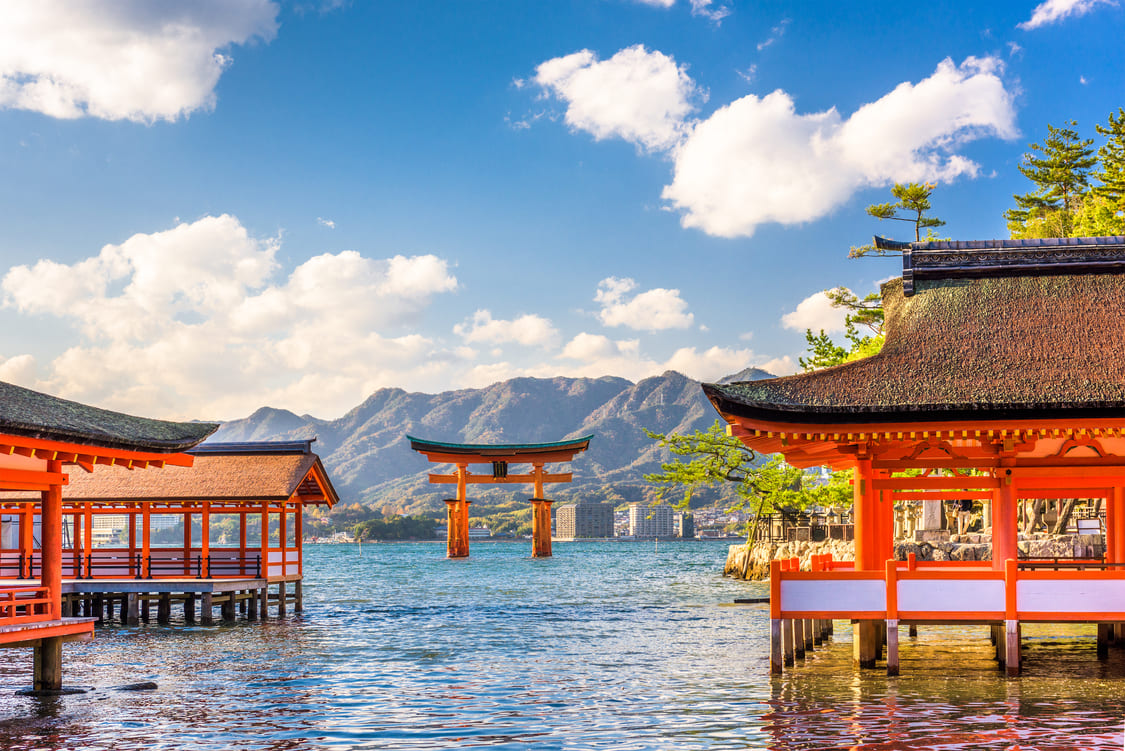
A ship floating in the Seto Inland Sea, Hiroshima PrefectureMiyajima(Itsukushima)Itsukushima ShrineIt is known for its large torii gate and shrine buildings standing in the sea, and in 1996World Cultural HeritageItsukushima Shrine has been registered as a World Heritage Site. This article summarizes what Itsukushima Shrine is, the reasons for its World Heritage designation, its history and the meaning of its torii gate, its highlights, access, and admission fees.
- What is Itsukushima Shrine?
- The history of Itsukushima Shrine
- Why was it built on the sea?
- The Charm of Itsukushima Shrine's Architecture and Structure
- Criteria for Itsukushima Shrine's World Heritage designation
- Registration Criteria (i): Original and beautiful landscapes that harmonize with nature
- Registration criterion (ii): Cultural exchange spread through architectural styles
- Registration Criteria (iv): Advanced Technological Systems in Offshore Construction
- Registration criterion (vi): Symbols of spiritual culture shaped by nature worship.
- Access, Admission Fee, and Basic Information
- summary
What is Itsukushima Shrine?
First, let me give you an overview of Itsukushima Shrine as a World Heritage Site.
Background of its registration as a World Heritage Site
Itsukushima Shrine, registered as a UNESCO World Heritage Site in 1996, is one of Japan's most representative shrines, renowned for its unique complex of buildings built on the sea. Its architectural style, an adaptation of the Shinden-zukuri style, its vermilion corridors, and the ever-changing scenery with the ebb and flow of the tide have been recognized as possessing globally rare cultural value. In particular, the beautiful integration of the sea and the shrine architecture symbolizes the ancient faith and view of nature, demonstrating unparalleled universal value.
Overview of Cultural and Historical Value
Itsukushima Shrine is located on Miyajima, an island considered to be "the island where gods reside," and deeply reflects the Japanese belief that nature itself has long been revered as a sacred entity. The shrine buildings retain a strong influence of the aristocratic culture of the Heian period, and the elegant Shinden-zukuri style still exists today. Furthermore, Itsukushima Shrine is deeply connected to performing arts and festival culture, and has played an important role as a center of politics, religion, and culture throughout its long history, including its relationship with the Taira clan. Thus, its distinguishing feature is its comprehensive value, which is a fusion of architectural beauty and religious culture.
The reason why Miyajima is called the "Island of the Gods"
Since ancient times, Miyajima has been considered a sacred area, with its mountains, sea, and forests all treated as objects of worship. Mount Misen, the symbol of the island, has long been a place of ritual, and the natural landscape itself has been considered a dwelling place for gods. For this reason, it was considered sacrilegious to build shrines directly on the island, leading to the development of a unique style in which shrines are positioned as if floating on the sea. This combination of nature worship and geographical features has led to Miyajima being called the "Island of the Gods" to this day.
The history of Itsukushima Shrine
Founding and Development during the Heian Period
The origins of Itsukushima Shrine are said to date back to the 6th century, and it has long been worshipped as the guardian deity of maritime traffic. The current shrine buildings were established in the Heian period, and the elegant architectural style based on the Shinden-zukuri style was established during this time. In particular, the original design of placing the shrine buildings on the sea was born from a belief in the sacredness of nature itself and the idea that "the island itself is a sacred place." The architectural beauty that strongly reflects the culture of the Heian aristocracy is still highly regarded today.
The relationship between Taira no Kiyomori and Itsukushima Shrine
A major factor in Itsukushima Shrine becoming nationally known was its patronage by Taira no Kiyomori. As Kiyomori promoted the development of the Seto Inland Sea shipping routes, he deeply revered Itsukushima Shrine and dedicated himself to the large-scale construction of the shrine buildings and the protection of its festivals. Through this support, the shrine became closely connected to the political and economic center and increased its prominence as a center of cultural dissemination at the time. Much of the current magnificent shrine structure was formed during Kiyomori's era and is an indispensable element when discussing the historical value of Itsukushima Shrine.
Restoration from the Edo to Meiji periods and its transmission to the present day
During the Edo period, the shrine buildings were repeatedly repaired with the support of various feudal lords and the imperial court, ensuring the stable appearance of the shrine. In the Meiji era, the policy of separating Shinto and Buddhism led to improvements in the shrine grounds, establishing the current structure of the shrine. Furthermore, whenever the shrine was damaged by typhoons or storm surges, it was repaired each time, preserving traditional architectural techniques. Through these continuous efforts of repair and preservation, Itsukushima Shrine has retained its original appearance for over a thousand years, passing on its value as a cultural heritage to the present day.
Why was it built on the sea?
The faith of Miyajima as a "sacred place"
The primary reason Itsukushima Shrine was built on the sea is that Miyajima itself has been revered since ancient times as an "island where gods reside." To avoid directly defiling the island, the ideal form of worship was to allow worshippers to visit via the sea, so the shrine buildings were positioned to float on the sea rather than be built on land. This reflects the Japanese mountain worship and primitive Shinto beliefs that regard nature itself as sacred. With Mount Misen, considered a sacred mountain, as a backdrop, the structure in which the sea and architecture become one symbolizes the unique view of faith that has continued since ancient times.
The relationship between tidal range and architectural styles
The area around Miyajima experiences significant tidal differences; at low tide, sandy areas are exposed, while at high tide, the shrine buildings appear to float on the sea. The construction of Itsukushima Shrine cleverly incorporates this characteristic. Built on stilts, the shrine buildings create a beautiful, mirror-like landscape as the tide rises. The dynamic changes caused by the tides are integrated as part of the architecture, and this harmonious blend of nature and architecture has been appreciated as a unique aesthetic value from ancient times to the present day.
Structural reasons why the corridors and shrine buildings appear to float.
The pillars supporting the entire shrine are not driven into the seabed, but placed directly on the sand, upon which the building is constructed. This structure allows the entire building to flexibly adapt to strong currents and distribute the force. Furthermore, the straight line of the vermilion corridor, which changes its appearance with the tide, highlights the fantastical sight of a "shrine floating on the sea." This design philosophy, which takes nature into account, is a major characteristic of Itsukushima Shrine.
The Charm of Itsukushima Shrine's Architecture and Structure
Features and historical value of the large torii gate
The Great Torii Gate of Itsukushima Shrine, a symbol of the shrine, has a unique structure that stands on the sea. Its massive pillars are not embedded in the ground, but are stabilized solely by their own weight, making it resistant to toppling even in environments with large tidal fluctuations. The current Great Torii Gate was rebuilt during the Meiji period and boasts an impressive height of approximately 16 meters. This gate is not only a symbol of faith but also demonstrates advanced wooden construction techniques adapted to the natural environment, making it of extremely high historical and architectural value.
The beauty of the vermilion-painted corridor and the Shinden-zukuri architecture
The corridors connecting the shrine buildings are a magnificent structure stretching approximately 275 meters in length, incorporating the Shinden-zukuri style, which symbolizes the culture of the Heian aristocracy. The contrast between the vermilion pillars and the blue of the sea, and the ever-changing scenery due to the tides, captivates visitors. Furthermore, the corridors, which skillfully combine straight and curved lines, are designed to enhance the harmony between the sea surface and the architecture, and visitors can also enjoy the changes in color due to sunlight and the seasons. These elements form the unique elegance of Itsukushima Shrine.
Elevated floor and features to enhance durability
The architecture of Itsukushima Shrine employs a raised-floor structure to cope with the ebb and flow of the tides, allowing seawater to pass beneath the floor. Traditional techniques such as "root grafting" are used at the base of the pillars, and damaged sections can be replaced as needed, enabling long-term preservation. In addition, the floorboards are laid with gaps between them to allow the force of the waves to dissipate. These structural ingenious features are what have allowed the shrine to withstand the harsh environment of the sea for so many years.
The striking appeal of the flat stage and Noh stage
The flat stage and Noh stage, located at the center of the shrine complex, are important spaces where Shinto rituals and performing arts are held, and the backdrop, integrated with the sea, enhances the performances. The Noh stage, in particular, is known as one of the oldest floating stages in Japan and is of great value as a stage for traditional performing arts. The harmony between the surrounding nature and the architecture completes the beauty of Itsukushima Shrine as a festive space.
Criteria for Itsukushima Shrine's World Heritage designation
Registration Criteria (i): Original and beautiful landscapes that harmonize with nature
Itsukushima Shrine is highly regarded for its landscape where the sea and architecture are integrated. The shrine buildings are positioned on the sea, and the temple complex, incorporating the elegance of the Shinden-zukuri style, along with the vermilion-lacquered corridors, demonstrates exceptional creativity. In particular, the unique beauty of the buildings, which changes in appearance with the ebb and flow of the tide, is rare in the world and is highly regarded internationally as a creative landscape that incorporates the natural environment itself.
Registration criterion (ii): Cultural exchange spread through architectural styles
Itsukushima Shrine developed from ancient to medieval times, deeply intertwined with politics, faith, and culture, and played a role in transmitting Heian aristocratic culture to the provinces. Its application of the Shinden-zukuri architectural style to religious architecture is considered a significant innovation in architectural history. Furthermore, its connections with the Taira clan and exchanges along the Seto Inland Sea coast facilitated the exchange of diverse cultural elements, contributing to the development of regional culture. This widespread architectural and cultural influence is highly regarded.
Registration Criteria (iv): Advanced Technological Systems in Offshore Construction
The structure of the shrine built on the sea, its raised floor design to accommodate tidal differences, and its layout that prioritizes harmony with the natural environment are excellent examples of historical architectural techniques. In particular, the fact that it has maintained its Heian period configuration without significant changes to this day is extremely valuable for architectural history research. Itsukushima Shrine systematically demonstrates the techniques for traditional architecture to coexist with nature, and holds significant value in understanding the development process of Japanese architecture.
Registration criterion (vi): Symbols of spiritual culture shaped by nature worship.
Itsukushima Shrine is highly regarded as a symbol of Japan's unique spiritual culture, which regards nature itself as sacred. The belief that the entire island of Miyajima is a sacred area has continued since ancient times, and its unique structure, with the shrine buildings situated on the sea amidst a landscape where mountains, sea, and forests are integrated, concretely represents a religious view that harmonizes with nature.
Furthermore, Itsukushima Shrine has historically functioned as a place where religious rituals, performing arts, and politics intersected. Under the patronage of the Taira clan, festivals and performing arts flourished, and the Noh stage, in particular, is known as a symbolic representation of this. The festivals and performing arts that have been held here have been passed down as a tradition that combines Japanese religious culture and art. Due to this accumulation of spirituality and cultural practices, Itsukushima Shrine is recognized as having important value as a symbol of spiritual culture.
Access, Admission Fee, and Basic Information
JR MiyajimaguchiorHiroshima Electric Railway MiyajimaguchifromMiyajima Matsudai SteamshiporJR West Miyajima FerryFrom there, it's about a 10-minute ride to Miyajima Pier. From the pier, it's about a 10-minute walk to Itsukushima Shrine. There is an entrance fee, and opening and closing times vary depending on the season. For the latest information on entrance fees and opening times, please see below.Itsukushima Shrine OfficialandMiyajima Tourism AssociationPlease check there.
DetailsUNESCO World Heritage CentrePlease refer to
summary
Itsukushima Shrine is a representative World Heritage Site of Japan where nature and architecture are in perfect harmony, and the beauty of the shrine buildings that seem to float on the sea is breathtaking no matter how many times you see them. Knowing the history of how the entire island of Miyajima has been protected as a sacred area, and the cultural background built by Taira no Kiyomori, makes the profound charm of this place even clearer. The scenery that changes with the ebb and flow of the tides and the elegance of the vermilion corridors are truly one of a kind. Itsukushima Shrine, where history, architecture, and faith are fused together, feels like a special place where you can discover something new every time you visit.
 English
  日本語
日本語
YouTubeI've also released a vlog I made when I actually visited Itsukushima Shrine (Miyajima) in 2025! Please check it out for information on the scenery of the Great Torii gate and shrine buildings, the atmosphere of the approach to the shrine and the shopping street, and gourmet food!