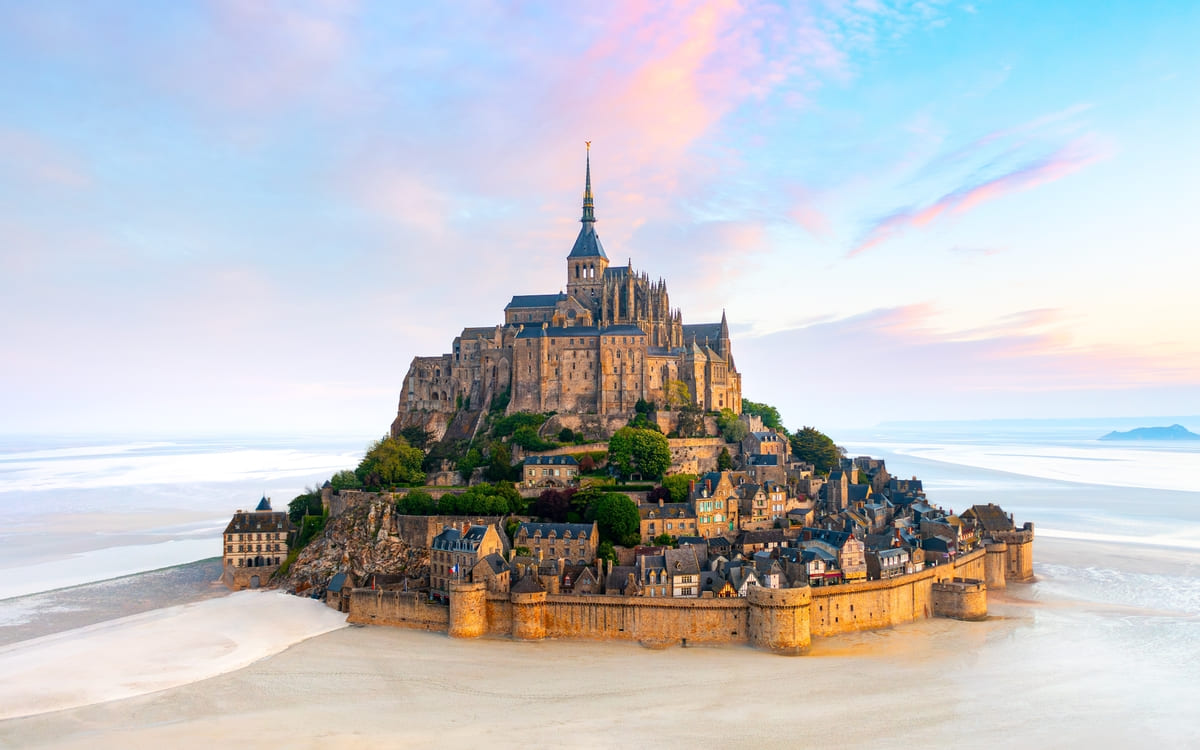
Located in northwestern France, on the border of Normandy and Brittany.Mont Saint-MichelIt was established in 1979 as a monastery island floating in a bay that changes its appearance as land and sea with the ebb and flow of the tides.World Cultural HeritageIt has been registered as a World Heritage Site. This article summarizes essential information you should know before traveling to Mont Saint-Michel, including what it is, the reasons for its World Heritage designation, its history and highlights, and how to get there.
What is Mont Saint-Michel?

Mont-Saint-Michel isBay of Saint-MaloThe rocks facing the bay form an island, and on its summit is a Benedictine monastery and a surrounding village, making it a cultural heritage site. The bay is one of Europe's leading bays.Large tidal rangeIn this sea area, the island is surrounded by the sea at high tide and becomes connected to the mainland at low tide. The World Heritage site is not just the monastery itself, butA cultural landscape woven from the island, the monastery, and the entire bay.is.
Basic information about Mont Saint-Michel
| item | Contents |
|---|---|
| Official name | Mont-Saint-Michel and its Bay |
| location | Normandy region (Manche department) in northwestern France |
| Main composition | Monastery (built between the 11th and 16th centuries), village on the island, bay tidal flats |
| Year of World Heritage designation | 1979 |
Often referred to as a "Wonder of the West," its silhouette is cherished as a unique landscape where faith and nature are intertwined.
The reason Mont Saint-Michel became a World Heritage Site
Reasons for UNESCO registrationNow, let's look at Mont Saint-Michel and its bay.Three registration criteriaIt is valued as a heritage site possessing outstanding universal value that meets the following criteria.
- Criterion (i): Natural environment and architectureA one-of-a-kind combinationAs a result, it has achieved unparalleled aesthetic success. The monastic architecture, built to adapt to its challenging location, is considered a masterpiece of human creative genius.
- Criterion (iii)It is praised for conveying unique evidence of a vanished civilization. The coexistence of a monastery and a fortified village within the limited space of a small island creates an unparalleled ensemble, and the arrangement of the buildings forms an unforgettable silhouette.
- Criteria (vi): Directly linked to events or traditions of outstanding universal value.Important pilgrimage sitesIt is one of the places deeply associated with the worship of the Archangel Michael.
In short, its harmony with nature and architecture, its evidence of medieval monastic culture, and its role as a symbol of faith were all recognized, leading to its designation as a World Heritage Site.
The History of Mont Saint-Michel
Origins and the establishment of monasteries

According to tradition, in the early 8th centuryArchangel MichaelIt is said that a bishop, having received a divine message, built a church on this rocky hill. In 966, a Benedictine monastery was founded, and from the 11th to the 16th centuries, additions continued, changing in style from Romanesque to Gothic. The skill and artistry involved in stacking buildings on a limited rocky hill were remarkable.La MerveilleThis is exemplified by the part that is called "(amazing)".
The Hundred Years' War and the "Unconquerable Monastery"
During the late Middle Ages and the Hundred Years' War, Mont Saint-Michel was fortified and never fell to the English army. Its role as both a religious institution and a defensive structure strengthened its symbolic significance as a spiritual pillar for France. After the French Revolution, the monastery was temporarily used as a prison, but in the 19th century it was protected as a historical monument and underwent restoration.

Restoration of the "island" in the bay
A levee built in 1879 permanently connected the island to the mainland, and sedimentation in the bay was progressing, causing it to lose its "island" characteristics. In 2015, a large-scale construction project by the French government rebuilt the levee.Pedestrian overpassIt was replaced, and the tidal currents recovered.Mont Saint-Michel once again surrounded by the sea.It's back! Parking is available on the opposite shore in La Casarne, from where you can take a shuttle bus or walk to the island.
Monastery and scenic attractions
monastic architecture
The monastery is a blend of Romanesque and Gothic architecture, built in stages to conform to the top of the rocky hill. "La Merveille" features a guest hall (Sarre des Zets), a knights' hall (Sarre des Chevaliers), a cloister, and a refectory, with its impressive three-dimensional layout within a limited site. The monastery church's choir was rebuilt in 15th-century Flamboyant Gothic style.
The village and Grand Rue
The island extends all the way to the gates of the monastery.Grand RueThe village spreads out from Grande Rue. Souvenir shops and restaurants line the street, and the path leads uphill towards the abbey. The views of the bay and the sandy landscape at low tide are unique Mont Saint-Michel experiences.

Tides and safety
In the bay, the tides come and go very quickly, and if you are walking on the sand at low tide,Official guided tourWe strongly recommend using [a specific method/service]. Entering the tidal flats on your own carries the risk of being stranded when the tide comes in.
Access and basic information about Mont Saint-Michel
From Paris
- TGV + Rental Car/BusFrom Paris Montparnasse, take the TGV to Rennes. From Rennes, take a direct bus to the Mont Saint-Michel parking lot (La Casarne). The journey takes approximately 3.5 to 4 hours from Paris.
- carIt's about 360km from Paris. It can be accessed via Caen or Rennes.
From the parking lot (La Casarne) to the island,Free shuttle busorwalking(Pedestrian overpass, approximately 2.5km). Since the island has many cobblestone slopes, comfortable walking shoes are recommended.
Monastery admission and opening hours
Monastery entrance fee and opening hours: **Monastery official websiteorTourism Bureau**Please check the latest information (please check the official website for fees and opening hours as of March 2026).** Entry may be restricted or reservations may be required during peak hours.
Regarding other World Heritage sites in France,Palace of VersaillesorThe banks of the Seine River in ParisPlease also see the related article.
Sightseeing tips and points to note
Best season and crowds
The weather is pleasant from spring to autumn, with crowds concentrated during summer and long weekends. Visiting early in the morning, in the evening, or on weekdays will allow for a more relaxed visit. The scenery changes with high and low tide, so checking the tide table beforehand will allow you to capture the moment when the island appears to float on the sea.
What to wear and what to bring
The island has many slopes and stairs, and the streets are paved with cobblestones. Please wear comfortable shoes. Also, bring appropriate warm and windproof clothing as needed.
summary
Mont Saint-Michel, a UNESCO World Heritage Site, is a representative French landscape recognized for its "harmony of nature and architecture," "evidence of medieval monastic culture," and "symbol of faith." Understanding the reasons for its designation and its history will make your trip even more memorable as you slowly enjoy the scenery of the abbey and bay. When accessing the site, be sure to check parking, shuttle, and tide information in advance, and always enjoy walking on the mudflats safely with an official guide.
 English
  日本語
日本語
YouTubeでは、2025年に実際に僕がモン・サン・ミッシェルを訪れた際に撮影したVLOGも公開しています!島の内部の様子も堪能できるので、ぜひご覧ください◎