
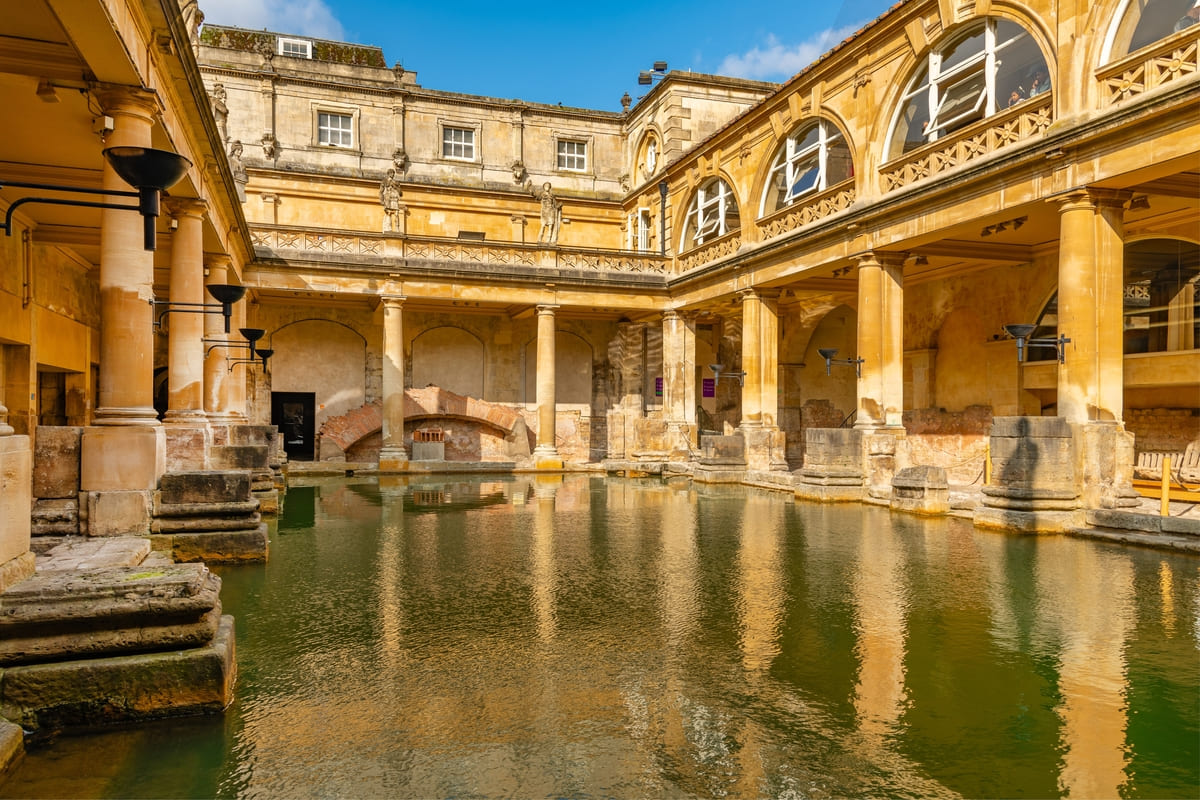
Bath, a World Heritage Site located in the southwest of England, is a rare entity that combines its origins as a spa town in ancient Rome and its appearance as a planned city formed in the 18th century Georgian period, all in one urban space.The intrinsic value of Bath lies in the fact that it is not simply a collection of historical buildings, but the "city itself" is valued as a cultural heritage site.
In this article, we will examine the historical process through which Bath was formed and why it is highly regarded as a World Heritage Site, looking at two axes: the city's history, which began with the Roman Baths, and the cultural significance of its Georgian-style urban landscape.
What is the World Heritage Site Bath?
The World Heritage city of Bath is located in Somerset in southwest England, and continues to tell the story of its origins as a hot spring town built in ancient Roman times and its appearance as a planned city completed in the 18th century. It was registered as a UNESCO World Heritage Site in 1987, and its greatest feature is that the entire city, rather than a single building or ruin, is evaluated as a heritage site.
In Bath, the remains of the baths built by the Roman Empire and the streets, houses, and squares based on modern European urban planning ideas have been preserved so that they overlap in the same urban space. There are few examples of urban structures from different eras being inherited in such an uninterrupted way, and Bath has been positioned as a World Heritage Site where you can experience the history of the city itself.
The historical value of Bath, beginning with the Roman Baths
The history of Bath dates back to the 1st century AD, when the Romans arrived and built a bath city using natural hot springs. The Romans called this city "Aquae Sulis" and developed it into a city with not only bathing facilities but also temples and public spaces.
Roman baths were not just sanitary facilities, but also played an important role as places for religious ceremonies, social activities, healing, and relaxation. Hot springs were linked to the belief in "Sulis Minerva," a syncretism of the indigenous goddess Sulis and the Roman goddess Minerva, and were a symbol of the fusion of Roman and indigenous cultures.
After the decline of the Roman Empire, Bath's functions as a city temporarily declined, but the hot springs themselves continued to be used without interruption. This "continuous use of hot spring resources" has been the foundation that consistently supports Bath's urban history.
Cultural value of the urban landscape created by the 18th century Georgian style
From the end of the 17th century to the 18th century, the medicinal value of hot springs was rediscovered, and Bath once again attracted attention as a city for health and social interaction. In particular, during the Georgian period of the 18th century, Bath rapidly developed as a city where aristocrats and the upper classes gathered, and large-scale urban development was carried out.
The architects who led the urban development of this era were father and son John Wood. Rather than designing individual buildings independently, they planned the entire city, including streets, squares, and residential areas, as a unified structure. This resulted in a harmonious urban landscape with well-balanced facades, the use of uniform materials, and a regular block structure.
Bath's Georgian cityscape is not merely an architectural beauty; it also has great cultural value as an embodiment of the ideal city and social culture of 18th century Europe.
Why Bath was inscribed on the World Heritage List
The reason Bath was recognized as a World Heritage Site is that the ancient heritage of the Roman Baths and the modern Georgian urban planning exist contiguously within a single urban space. The fact that the development process of the city from ancient to modern times can be clearly seen both visually and structurally has been highly praised internationally.
Criterion (i) recognizes that Georgian urban design is a masterpiece that demonstrates human creative genius. Criterion (ii) demonstrates that the city is marked by the exchange and succession of different eras and civilizations: Roman culture and modern British culture. Criterion (iv) is based on the city's urban structure, which represents the historical stages from a bath city to a planned city.
The combination of these elements has led to Bath being registered as a World Heritage Site, not just as a spa city, but as a "cultural heritage site that shows the evolution of the city itself."
summary
The essential value of the World Heritage Site of Bath is that it demonstrates in a single urban space how mankind has built, developed, and passed down cities, with hot springs as its core natural resource. The fact that the ancient Roman culture of public baths and the 18th century idea of planned cities have overlapped seamlessly, and that the city continues to function today, is a unique feature.
Bath is a "living urban heritage" that preserves multiple layers of historical and cultural value, and it can be said that it is a city that clearly embodies the significance of being registered as a World Heritage Site.
 English
  日本語
日本語